

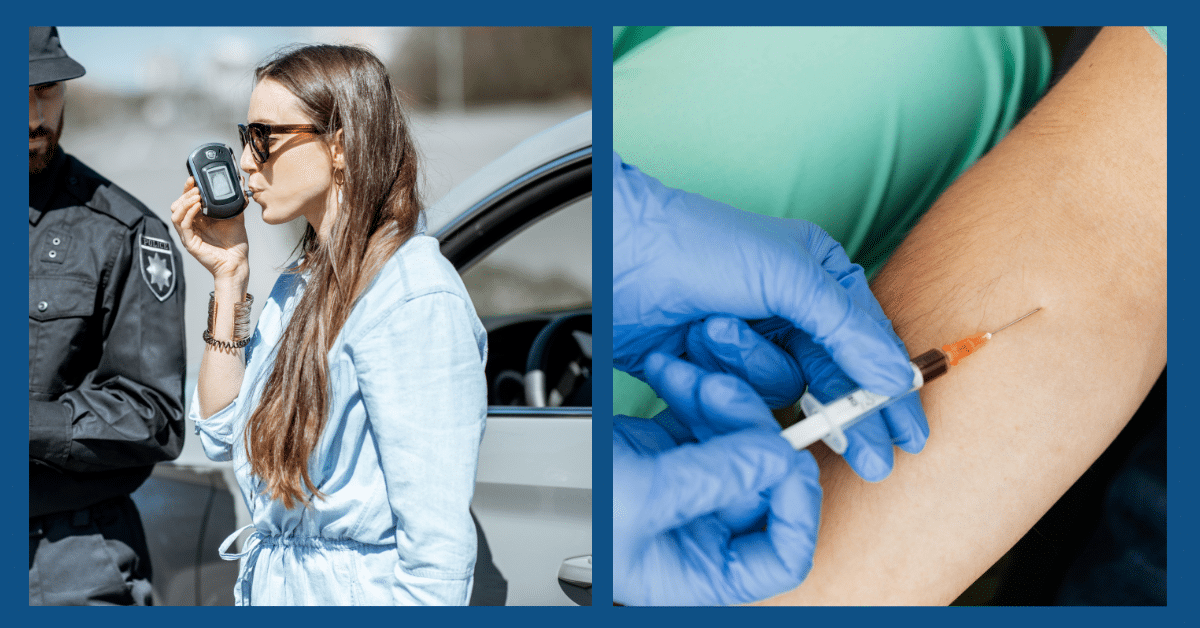
When an officer pulls you over for suspected driving under the influence, they will likely conduct testing to assess your blood alcohol content (BAC). Two types of testing are routine in this scenario: breath tests and blood tests. The officer may use both to assess your level of impairment. In Colorado, you generally have the right to choose between a breath test and a blood test. However, if the officer suspects impairment from drugs other than alcohol, they can require you to take a blood test.
Understanding the differences between Colorado DUI breath tests and blood tests can clarify how the results of each may impact your potential legal case.
What Happens If You Refuse Alcohol Testing?
You may wonder whether you can refuse one type of alcohol testing in favor of another.
In Colorado, drivers can refuse field sobriety tests; however, refusal can sometimes lead an officer to make an arrest based on other observed signs of impairment. They would then require you to complete chemical testing to assess your blood alcohol concentration (BAC), which may include a breathalyzer test and blood testing.
Refusing chemical alcohol testing is not a criminal offense in Colorado, but it carries significant administrative penalties, including immediate suspension of your driver’s license and a Persistent Drunk Driver designation under Colorado’s Express Consent Law. This designation would require you to complete a Level II Alcohol and Drug Education and Treatment course and use an ignition interlock device for at least two years upon restoring your driving privileges.
Pros and Cons of a DUI Breath Test vs. Blood Test
Breath and blood tests offer distinct benefits and potential disadvantages that may impact your case.
Breath tests are fast and non-invasive, but they are generally less accurate than blood tests and may be prone to errors. Blood tests are more accurate and can detect substances other than alcohol. They also take longer to process and sometimes produce higher BAC results than breath tests.
Keep in mind that each testing type has its limitations and may be subject to being challenged by a DUI defense attorney.
Suppression Strategies for DUI Testing
An experienced legal professional might take several approaches to challenging the prosecution’s evidence against you in a DUI case. Here are a few examples:
- Lack of probable cause: They might challenge the legality of the traffic stop by asserting that there was no probable cause to administer breath or blood testing.
- Chain of custody issues: They might look for gaps in documentation, labeling, or storage to challenge the integrity of the test results or cite chain of custody problems.
- Drawing and storage problems: They might assert that the actual testing procedures were incorrect or that the tests were stored improperly, leading to inaccuracies.
- Machine calibration and operator certification: Evidentiary breathalyzer machines must be calibrated every 6-12 months, and the operators must be certified,
An attorney can review the circumstances of your case and the prosecution’s evidence to determine an appropriate defense strategy.
Seek Support From Churchill DUI Defense
Knowing the differences between DUI breath tests and blood tests and how each could be challenged can help you understand the strength of the prosecution’s case against you. Churchill DUI Defense represents clients facing DUI charges in the Denver area. Contact us today at (303) 832-9000 for a consultation with our DUI defense attorneys.